Roman Occupation
What is the place of Roman Occupation in biblical history?
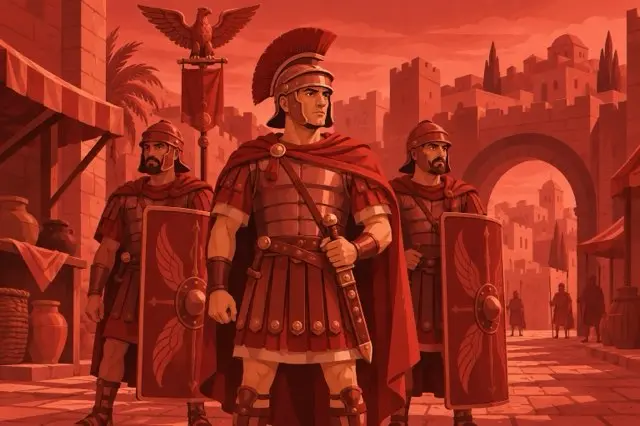
Roman Occupation is the political and military control that Rome held over Judea. Rome's political and military control of Judea
- Role
- Rome's political and military control of Judea
- Beginning of Roman Rule
- 63 BC (Pompey conquered Jerusalem)
- Direct Roman Governance of Judea
- 6 AD (after Archelaus was deposed)
- Prefect During Jesus's Ministry
- Pontius Pilate (26-36 AD)
- Galilean Ruler
- Herod Antipas (son of Herod the Great)
- End of Jewish Revolt
- 70 AD (Temple destroyed); 73/74 AD (Masada falls)
- Key Scripture
- Luke 23:6-12, John 18:31, John 19:19
More in the app
The people, places and passages behind it, in one place.
Explore Roman Occupation in the appWhy This Reality Matters
"Is it lawful to pay taxes to Caesar, or not?" The question was a trap, and everyone knew it. Say yes, and Jesus loses the people, a collaborator with Rome. Say no, and Rome executes Him for sedition. The political tension crackling through that exchange permeated every moment of Jesus's ministry. Roman soldiers patrolled Jerusalem's streets. Roman taxes crushed peasant families. Roman crosses lined the roads as warnings to anyone who challenged the empire's authority. When Jesus was crucified, the charge posted above His head read "King of the Jews", Rome's mocking reminder of what happened to rival kings. Into this occupied land, God sent not a military liberator but a suffering servant. The kingdom He proclaimed was "not of this world." Many who longed for freedom from Rome found His answer confusing, even disappointing. They wanted a Messiah on a war horse. He came on a donkey.
Historical Background
Rome's involvement with Judea began in 63 BC when the Roman general Pompey conquered Jerusalem during a Jewish civil war. What had been the independent Hasmonean kingdom became a client state of Rome. The Romans initially ruled through local Jewish rulers, most notably Herod the Great (37-4 BC), who rebuilt the Temple magnificently but was despised for his cruelty and his compromises with pagan culture.
After Herod's death, his kingdom was divided among his sons. When one son, Archelaus, proved incompetent, Rome removed him and placed Judea and Samaria under direct Roman rule in AD 6. From then until the Jewish revolt of AD 66-70, Roman prefects (later called procurators) governed the region.
In the First Century
During Jesus's public ministry, Judea was governed by Pontius Pilate (AD 26-36), while Galilee and Perea remained under Herod Antipas, a son of Herod the Great. This division explains why Jesus was sent to Herod during his trial (Luke 23:6-12), he was a Galilean, technically under Herod's jurisdiction.
Key Characteristics
The Roman occupation involved:
- Taxation: Heavy taxes including poll taxes, land taxes, and customs duties funded Rome's military and administration
- Military presence: Auxiliary troops (typically 3,000-6,000 soldiers) maintained order, with reinforcements brought to Jerusalem during festivals
- Limited Jewish autonomy: The Sanhedrin retained authority over religious matters but could not execute capital punishment without Roman approval (John 18:31)
- Roman law for political crimes: Sedition and claims of kingship were tried by the prefect
- Religious accommodations: Rome exempted Jews from emperor worship and allowed Temple worship to continue
Social Position
Jews under Roman rule occupied a complex position. The aristocratic Sadducees generally cooperated with Rome to preserve their status and the Temple. The Pharisees focused on religious observance while accepting foreign rule as God's providence. Others were less accommodating, the Zealots advocated armed resistance, while the Essenes withdrew from society entirely.
The common people bore the heaviest burden. Taxation, combined with Temple tithes and offerings, could consume 30-40% of a family's income. Many fell into debt, lost their land, and became day laborers or worse.
Religious Significance
Roman rule raised profound theological questions. Had God abandoned his people? Why did he allow pagans to rule the Holy Land? The prophets had promised that God would establish his kingdom and restore Israel. Where was that kingdom?
These questions fueled messianic expectations. Many Jews expected a Messiah who would be like David, a warrior king who would defeat Israel's enemies and reign from Jerusalem. The Dead Sea Scrolls reveal how intensely some communities anticipated God's imminent intervention.
Political Implications
The political situation was explosive. Judea under Roman rule experienced multiple revolts and uprisings. Judas the Galilean led a revolt against the census of AD 6, arguing that paying taxes to Rome was treason against God. His movement evolved into the Zealots.
The Romans crushed resistance brutally. Crucifixion, the penalty Jesus suffered, was Rome's punishment specifically for slaves and rebels. It was designed not just to kill but to humiliate and terrorize. Thousands of Jews were crucified along Roman roads as warnings against sedition.
Why Jesus's Actions Were Controversial
Jesus navigated this volatile environment with remarkable subtlety:
The tribute question (Matt 22:15-22): "Is it lawful to pay taxes to Caesar?" was a trap. Saying yes would alienate the people; saying no would be sedition. Jesus's answer, "Render to Caesar what is Caesar's, and to God what is God's", brilliantly avoided the trap while asserting God's ultimate sovereignty.
The "King of the Jews" claim: This was the charge that led to crucifixion. From Rome's perspective, anyone claiming to be a king in territory under Caesar's rule was committing treason. Pilate's inscription on the cross, "Jesus of Nazareth, King of the Jews" (John 19:19), was both a mockery and a statement of the charge.
The different kind of kingdom: Jesus proclaimed that his kingdom was "not of this world" (John 18:36). This confused everyone, followers who expected military victory, religious leaders who feared Roman reprisals, and Romans who saw any kingdom claim as threatening.
Theological Significance
The Roman occupation reveals that God's plan for salvation moved through history's darkest political realities, not around them. The census that brought Joseph and Mary to Bethlehem was a tool of imperial taxation, and it fulfilled Micah's prophecy. The crucifixion was Rome's method for terrorizing subject peoples, and it became the instrument of the world's redemption. God did not wait for political conditions to improve before acting. He entered the mess.
Jesus's reconciliation of Simon the Zealot and Matthew the tax collector, a revolutionary and a collaborator sitting at the same table, demonstrated the radical nature of his kingdom. Political enemies became brothers. The divisions that defined first-century Jewish society were transcended not by choosing a side but by creating something entirely new.
The cross itself speaks to this. Crucifixion was Rome's statement: We have ultimate power over your body and your dignity. The resurrection was God's answer: No, you don't. The empire that crucified Jesus would eventually bow before Him. The method of execution became the symbol of victory. Rome meant the cross as an ending. God made it a beginning.
Quick Facts
- Beginning of Roman Rule: 63 BC (Pompey conquered Jerusalem)
- Direct Roman Governance of Judea: 6 AD (after Archelaus was deposed)
- Prefect During Jesus's Ministry: Pontius Pilate (26-36 AD)
- Galilean Ruler: Herod Antipas (son of Herod the Great)
- End of Jewish Revolt: 70 AD (Temple destroyed); 73/74 AD (Masada falls)
Scripture References
- Luke 2:1-5, The census at Jesus's birth brings Joseph and Mary to Bethlehem
- Matthew 22:15-22, The tribute question: "Then the Pharisees, going out, took counsel as to how they might entrap him in speech. And they sent their disciples to him, with the Herodians, saying: “Teacher, we know that you are truthful, and that you teach the way of God in truth, and that the influence of others is nothing to you. For you do not consider the reputation of men. Therefore, tell us, how does it seem to you? Is it lawful to pay the census tax to Caesar, or not?” But Jesus, knowing their wickedness, said: “Why do you test me, you hypocrites? Show me the coin of the census tax.” And they offered him a denarius. And Jesus said to them, “Whose image is this, and whose inscription?” They said to him, “Caesar’s.” Then he said to them, “Then render to Caesar what is of Caesar; and to God what is of God.” And hearing this, they wondered. And having left him behind, they went away."
- Mark 15:7, Barabbas, an insurrectionist imprisoned for murder during an uprising
- John 18:28-19:16, Pilate's trial of Jesus on the charge of claiming kingship
- John 18:36, "My kingdom is not of this world"
- John 19:19, The inscription: "Then Pilate also wrote a title, and he set it above the cross. And it was written: Jesus the Nazarene, King of the Jews."
- Matthew 10:3-4, Simon the Zealot and Matthew the tax collector among the twelve
- Luke 23:6-12, Jesus sent to Herod Antipas during His trial
Keep exploring in the app
The Bible, the map, the timeline and the whole library, in one place.
Open the app