The Sower
What is the Sower about?
The Sower is a parable of Jesus about how the word of God takes root, or fails to. How the word of God takes root, or fails to
- Role
- How the word of God takes root, or fails to
- Key Scripture
- Matthew 13:1-2, Mark 4:1-2, Luke 8:4
More in the app
The people, places and passages behind it, in one place.
Explore The Sower in the appA sower goes out, and the seed meets four kinds of ground. Jesus does not leave the picture as a riddle. He names each soil, and the meaning is whether the word is received.
The Story
The crowd is too large for the shore. In the Gospel of Matthew, Jesus sits in a boat while the people stand on the land (Matthew 13:1-2). The Gospel of Mark uses that same boat and crowd (Mark 4:1-2). The Gospel of Luke tells the parable when a crowd is gathering from the towns (Luke 8:4).
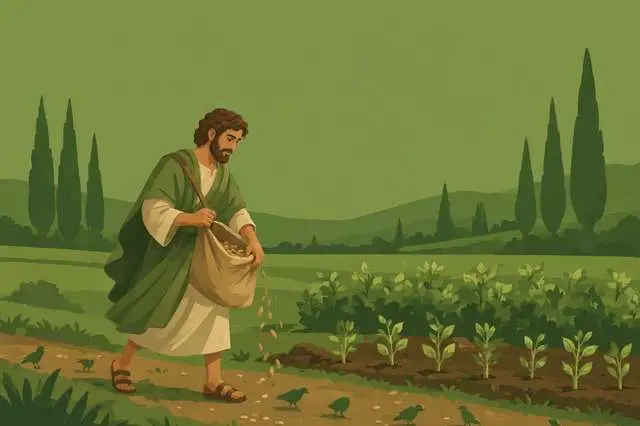
"And he spoke many things to them in parables, saying: “Behold, a sower went out to sow seed. And while he was sowing, some fell beside the road, and the birds of the air came and ate it. Then others fell in a rocky place, where they did not have much soil. And they sprung up promptly, because they had no depth of soil. But when the sun rose up, they were scorched, and because they had no roots, they withered. Still others fell among thorns, and the thorns increased and suffocated them. Yet some others fell upon good soil, and they produced fruit: some one hundred fold, some sixty fold, some thirty fold." (Matthew 13:3-8)
Four landings only. Matthew's good soil bears a hundredfold, sixty, or thirty. Mark names thirty, sixty, and a hundred (Mark 4:3-8). Luke adds trampling on the path, a rock without moisture, and a hundredfold from the good soil (Luke 8:5-8).
The disciples ask why he speaks in parables. He says the mysteries of the kingdom have been given to them, and he speaks of a people who hear and do not understand (Matthew 13:10-15). Mark says that missing this parable is the way to miss the others (Mark 4:13). Then Jesus explains. The explanation is the meaning. There is not a fifth soil.
"Listen, then, to the parable of the sower. With anyone who hears the word of the kingdom and does not understand it, evil comes and carries away what was sown in his heart. This is he who received the seed by the side of the road. Then whoever has received the seed upon a rocky place, this is one who hears the word and promptly accepts it with joy. But he has no root in himself, so it is only for a time; then, when tribulation and persecution occur because of the word, he promptly stumbles. And whoever has received the seed among thorns, this is he who hears the word, but the cares of this age and the falseness of riches suffocate the word, and he is effectively without fruit. Yet truly, whoever has received the seed into good soil, this is he who hears the word, and understands it, and so he bears fruit, and he produces: some a hundred fold, and another sixty fold, and another thirty fold.”" (Matthew 13:18-23)
He assigns four hearers and stops. The road is the word carried off by the evil one. The rock is joy without root when trouble comes because of the word. The thorns are the cares of this age and the falseness of riches. The good soil hears and bears fruit. The three numbers belong to that soil, not to three more grounds.
"He who sows, sows the word." (Mark 4:14)
Mark then names Satan on the path, trouble that topples stony ground, and thorns made of tasks, riches, and other desires (Mark 4:15-20). Luke calls the seed the word of God (Luke 8:11).
"But those which were on good soil are those who, upon hearing the word with a good and noble heart, retain it, and they bring forth fruit in patience." (Luke 8:15)
A good heart, the word kept, fruit in patience: still the fourth soil. Path, rock, thorns, good soil.
Where It Appears
- Primary text: Matthew 13:1-23, the sowing and Jesus' own explanation.
- Parallels: Mark 4:1-20 and Luke 8:4-15. All three keep four soils and an explanation. Luke alone has the trampling, the lack of moisture, and fruit in patience. Mark alone ties the other parables to understanding this one.
- Immediate context: This opens the parable discourse beside the sea. The disciples ask why he uses parables, and he answers before he explains the soils (Matthew 13:10-17). Next come the wheat and the weeds, the mustard seed, and the leaven.
- Related parables: The growing seed is a man who sleeps and rises and does not know how the seed grows. The mustard seed is a small beginning that becomes a place for birds. The wheat and the weeds is two plants left together until the harvest. None of those is a fifth soil.
- Lectionary: The Sunday in the bundled cycle is the 15th Sunday in Ordinary Time, Year A, Gospel Matthew 13:1-23. Mark 4:1-20 is Wednesday of the 3rd Week in Ordinary Time, and Luke 8:4-15 is Saturday of the 24th Week, in both weekday cycles.
Deeper Meaning
The center is reception of the word. The Catechism compares the word of the Lord to a seed sown in a field (CCC 543), and it says the parables are how Jesus invites people into his kingdom, and that they are like mirrors for man (CCC 546). This mirror asks which ground the word has met.
Jesus names the one who snatches the seed: the evil one, Satan, the devil. The rock is gladness that ends when trouble comes because of the word. The thorns are the cares and the falseness of riches, and, in Mark and Luke, the other desires and pleasures. The good soil hears, holds, and bears fruit, with patience in Luke. The hundred, the sixty, and the thirty stay inside that good ground.
Living It
The word will reach you in a particular way: a verse you open, the Gospel at Mass if you are Catholic, a sentence you already heard and did not keep. Before you sleep, name the ground.
If it was the path, read one sentence again and leave it where morning will find it. If it was rock, do one small act the word asked after the gladness cools. If it was thorns, set aside for seven days the one care, or the one false promise of riches, choking this seed. If it was good soil, do not grade your fruit against another hundredfold. Keep the word with the patience the Gospel of Luke names, and do the next thing that fruit asks.
Any Christian can make that inventory. If you are Catholic, let one phrase of the Gospel stay with you past the church door.
Going Deeper
Scripture connections
- The explanation is the boundary: Matthew 13:18-23, Mark 4:14-20, Luke 8:11-15.
- Why he speaks in parables: Matthew 13:10-17 and Mark 4:10-13.
- Nearby, and not the same story: the growing seed (Mark 4:26-29), the mustard seed, and the wheat and the weeds.
Church teaching
- CCC 543: "The word of the Lord is compared to a seed which is sown in a field."
- CCC 546: "Jesus' invitation to enter his kingdom comes in the form of parables" and "The parables are like mirrors for man." Here the mirror is the soil.
Reading tips
- Keep the four soils he names. Do not add a fifth meaning, and do not turn the yields into extra classes of people.
- Let each Gospel keep its detail. Trampling, lack of moisture, and patience are Luke's. They do not erase Matthew's cares and false riches, or Mark's line that the sower sows the word.
Keep exploring in the app
The Bible, the map, the timeline and the whole library, in one place.
Open the app