Noah
What does the Bible say about Noah?
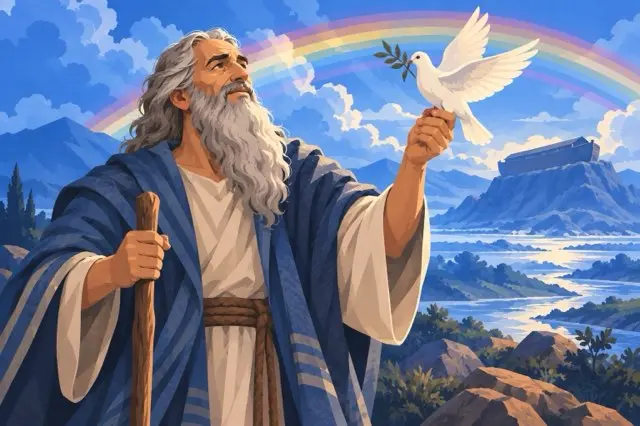
Noah is the righteous man of Genesis who built the ark that carried his family through the flood. Noah was a righteous man in the Book of Genesis who walked with God in a generation given over to wickedness. At God's command he built an ark that carried his family and the animals safely through the great flood. Afterward God made a covenant with him, setting the rainbow in the sky as a sign that the earth would never again be destroyed by flood.
- Role
- Builder of the Ark
- Scripture calls him
- A just man who walked with God
- His name
- Echoes rest and comfort
- Sign of the covenant
- The bow set in the clouds
- Key Scripture
- Genesis 6:9-22, Genesis 7:1-24, Genesis 9:8-17
Who Was Noah?
The world had filled with violence, and Scripture says God was "touched inwardly with a sorrow of heart." In the middle of it stood one man who still walked with God. He was told to build a vessel for a flood no one could see coming, and he built it while everyone around him went on eating and drinking. Noah's story begins in judgment, but it ends with God setting his bow in the clouds and binding himself by a covenant to every living thing. The Church has never stopped seeing in it a picture of Baptism: a few souls carried safely through the water into a new creation.
His Story
A Just Man in a Violent World
Genesis describes a world sliding downhill after the Fall. Cain's violence has spread, and now "the earth was corrupted before the eyes of God, and it was filled with iniquity" (Genesis 6:11). God does not look on this coldly. The text says he "repented that he had made man on the earth" (Genesis 6:6), a deeply human way of speaking about divine grief.
And then one quiet sentence changes the direction of the story:
"Yet truly, Noah found grace before the Lord." (Genesis 6:8)
Notice the order. Before Scripture tells us that Noah was just, it tells us that he found grace. His righteousness is real, "he walked with God" (Genesis 6:9), but it rests on a favor he did not invent.
The Command to Build
God speaks to Noah plainly: the end is coming, and he must make an ark of smoothed wood, sealed with pitch inside and out (Genesis 6:14). With the command comes a promise, and the first appearance of a word that will run through the whole Bible:
"And I shall establish my covenant with you, and you shall enter the ark, you and your sons, your wife and the wives of your sons with you." (Genesis 6:18)
Noah asks no questions that Scripture records. He simply obeys:
"And so Noah did all things just as God had instructed him." (Genesis 6:22)
The Letter to the Hebrews calls this faith: Noah, "having accepted an answer about those things which were not yet seen, being afraid, fashioned an ark for the salvation of his house" (Hebrews 11:7). Saint Peter calls him "the herald of justice" (2 Peter 2:5). His obedience was itself a sermon.
The Waters Rise
The animals go in, the family goes in, and then comes one of the most tender details in the whole account: "And then the Lord closed him in from the outside" (Genesis 7:16). Noah does not shut the door. God does.
"All the fountains of the great abyss were released, and the floodgates of heaven were opened. And rain came upon the earth for forty days and forty nights." (Genesis 7:11-12)
The waters of creation, which God had separated and set in order at the beginning (Genesis 1:6-9), close back over the earth. It is as though creation is being undone. "But only Noah remained, and those who were with him in the ark" (Genesis 7:23).
God Remembered Noah
At the very center of the Flood account stands this verse:
"Then God remembered Noah, and all living things, and all the cattle, which were with him in the ark, and he brought a wind across the earth, and the waters were diminished." (Genesis 8:1)
A wind over the waters: the same image as the first page of Genesis, when the Spirit of God moved over the deep. Creation is beginning again.
Noah waits. He sends out a raven, then a dove that finds no rest for her foot and comes back to his outstretched hand. Seven days later he sends her again, and she returns in the evening "carrying in her mouth an olive branch with green leaves" (Genesis 8:11). The dove and the olive branch have meant peace ever since.
The Bow in the Clouds
The first thing Noah does on dry ground is build an altar and offer sacrifice (Genesis 8:20). God responds with a promise that the seasons will not fail, and then with a covenant made not only with Noah but with "every living soul" (Genesis 9:10):
"I will place my arc in the clouds, and it will be the sign of the pact between myself and the earth." (Genesis 9:13)
Many readers have seen in the bow a warrior's weapon hung up in the sky. God binds himself, and he says he will look at it and remember (Genesis 9:16). It is the first covenant Scripture names, and it embraces the whole human family.
After the Flood
Scripture does not end Noah's story at the rainbow. He plants a vineyard, drinks too much of its wine, and lies uncovered in his tent (Genesis 9:20-21). The man who walked with God through the Flood is still a man, and the new world is not yet a sinless one. The honesty is part of the message: the Flood washed the earth, but it could not wash the human heart. That would take a greater water and a greater ark.
The episode ends with words of blessing and cursing spoken by Noah over his descendants (Genesis 9:25-27). The curse falls on Canaan, and readers have long seen in it the later history of Israel and the Canaanites. It was never a curse on any race or color of people, and its use to defend slavery was a grave abuse of Scripture.
What Happened to Him?
Genesis closes with the formula it uses for the ancestors before Abraham: "And all his days were completed in nine hundred and fifty years, and then he died" (Genesis 9:29). Through his sons the nations of the earth are traced out in the Table of Nations (Genesis 10), a way of saying that every people on earth belongs to one family under the covenant God made with Noah.
Scripture never forgets him. Ezekiel names him with Daniel and Job as models of justice (Ezekiel 14:14). Sirach praises him as "perfect and just" (Sirach 44:17). Jesus himself points to "the days of Noah" as a warning to stay awake for the coming of the Son of Man (Matthew 24:37-39).
Why He Matters Today
Connection to Christ
The New Testament reads Noah's ark as a sign of the salvation Christ brings:
- Baptism: Saint Peter writes that in the ark "eight souls, were saved by water. And now you also are saved, in a similar manner, by baptism" (1 Peter 3:20-21). At the Easter Vigil the Church blesses the baptismal water by recalling the Flood, where the end of sin became the beginning of goodness (CCC 1219).
- The Church: The Fathers saw the one ark, which alone carried life through the waters, as a figure of the Church (CCC 845).
- The dove: The dove returning over the waters is echoed when the Spirit descends like a dove on Jesus at his baptism in the Jordan (Matthew 3:16).
- The covenant with all nations: God's promise to every living thing points ahead to the new and everlasting covenant in Christ's blood, offered to every people.
Lessons for Us
1. Grace comes first: Noah "found grace" before he is called just. Our faithfulness is always a response to a love that came looking for us.
2. Obedience can be a witness: Noah preached mostly with a hammer. Quiet faithfulness, done day after day, speaks when words would not.
3. God closes the door himself: When we are carried through something we cannot control, we are not sealed in alone. The Lord who shut Noah in was keeping him safe.
4. Wait for the dove: Noah sent out the dove more than once. Hope sometimes means trying again after seven more days.
5. Even the just still need saving: Noah's failure after the Flood reminds us that no one outgrows the need for mercy.
Quick Facts
- Also Known As: Noe (Douay-Rheims spelling), the herald of justice
- Time Period: The primeval history of Genesis 1-11, before Abraham
- Role: Builder of the ark, partner in the first covenant of Scripture
- Name Meaning: Linked in Genesis to rest and comfort (Genesis 5:29)
- Family: A wife and three sons, Shem, Ham and Japheth, who entered the ark with him
Character Portrait
- Graced: He found favor with God before anything is said of his virtue
- Obedient: He did "all things just as God had instructed him," without a recorded word of protest
- Patient: He waited out the waters and waited again for the dove
- Worshipful: His first act on dry land was to build an altar
- Human: His drunkenness after the Flood shows that he, too, needed mercy
Going Deeper
Scripture References
- Primary Passages: Genesis 6-9
- Other Appearances: Ezekiel 14:14, 20; Wisdom 10:4; Sirach 44:17-18
- New Testament Connections: Matthew 24:37-39; Luke 17:26-27; Hebrews 11:7; 1 Peter 3:20-21; 2 Peter 2:5
Historical Context
Genesis 1-11 tells the story of the world before Abraham in the literary forms of its own time. Other peoples of the ancient Near East also told of a great flood, but Genesis tells it differently: one God, grieved by sin rather than annoyed by noise, who saves the just and binds himself by a covenant. The Church does not ask us to read these chapters as a scientific chronology (CCC 337, 390). It asks us to receive the truths God teaches through them, reading each passage according to its literary form (Dei Verbum 12).
Keep exploring in the app
The Bible, the map, the timeline and the whole library, in one place.
Open the app