Sign of the Cross
What is the Sign of the Cross?
The Sign of the Cross is the simple gesture and prayer with which Christians begin and end their prayers, marking themselves in the name of the Father, Son, and Holy Spirit. It is at once a profession of faith in the Trinity and a remembrance of Christ's saving cross. Among the first prayers a Christian learns, it sanctifies the whole of daily life.
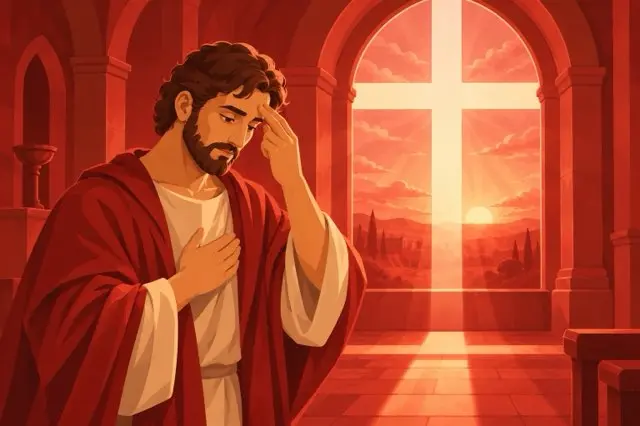
- Role
- Traditional Catholic prayer
- Also Known As
- Signum Crucis
- Origin
- Apostolic era (1st century); written evidence from Tertullian (204 AD)
- Category
- Foundational Prayer
- Scripture Basis
- Matthew 28:19 (Trinitarian baptismal formula)
- Liturgical Use
- Opens and closes all liturgical celebrations, blessings, and sacraments
- When to Pray
- Beginning and end of prayer, entering/leaving church, before meals, in moments of need
- Key Scripture
- Matthew 28:19, 2 Corinthians 13:13, Galatians 6:14
More in the app
The people, places and passages behind it, in one place.
Explore Sign of the Cross in the appThe Prayer
In the name of the Father,
and of the Son,
and of the Holy Spirit.
Amen.
Why This Prayer Matters
Before shoes went on, before bread was broken, before a candle was lit, early Christians traced a cross on their foreheads. In a world where professing Christ could mean death, this tiny gesture was an act of defiance: claiming the instrument of Roman execution as a sign of hope. Tertullian wrote in 204 AD that believers made the sign "at every step and movement, at every going in and out." Two thousand years later, it remains the most repeated prayer action in Christian history, the gateway to all other prayer, the physical confession that we belong to the God who is Father, Son, and Holy Spirit.
The Story Behind the Prayer
A Secret Sign
The earliest Christians had no church buildings, no public liturgy, no freedom to worship openly. What they had was a gesture, a small cross traced on the forehead with one finger. St. Basil later testified that this practice came from the Apostles themselves, passed down through oral tradition before anyone thought to write it down.
In the first three centuries, making this sign was dangerous. Christians were called "cross worshippers" and "adorers of the gibbet" by their pagan neighbors. The cross was Rome's instrument of execution, reserved for slaves, traitors, and the worst criminals. To claim it as a holy symbol was shocking. To mark yourself with it was a declaration of allegiance that could cost your life.
From Secret to Sacred
"Go, therefore, and make disciples of all nations, baptizing them in the name of the Father, and of the Son, and of the Holy Spirit.", Matthew 28:19
When Constantine legalized Christianity in 313 AD, the cross moved from hidden gesture to public emblem. The Council of Nicaea in 325 AD solidified the Trinitarian theology that the words express, "Father, Son, and Holy Spirit" became not just a baptismal formula but a creed embedded in movement.
Over the following centuries, the gesture itself evolved. The small forehead cross of the catacombs grew into the full-body gesture we know today, forehead to chest, shoulder to shoulder, first documented in the fifth century and spread throughout Christendom by monastic communities. Western Catholics cross from left to right; Eastern Orthodox from right to left, a thousand-year distinction still visible in every liturgy.
A Gesture That Never Stopped
According to tradition, when enemies tried to poison St. Benedict with wine, he made the sign of the cross over the cup and it shattered. Whether literal or legendary, the story captures what Christians have always believed about this prayer: it is not empty ritual. It is an invocation of divine power over darkness, a claim that the cross of Christ stands between the believer and evil.
What This Prayer Means
In fifteen words and one physical movement, the Sign of the Cross confesses the entire Christian faith. The words name the Trinity, the God who is one nature in three Persons. The gesture traces the cross, the place where redemption was accomplished. Together, they recall baptism, the moment when each Christian was first marked with this sign and claimed for God.
The prayer is both a beginning and an ending. It opens every Mass, every Rosary, every blessing. It closes every prayer, every sacrament, every liturgical act. It is the frame around everything the Church does, a reminder that all of Christian life takes place "in the name of" a God who gave Himself on a cross.
The physical gesture matters. This is not a prayer of the mind alone. When your hand moves from forehead to chest, you are saying with your body what you believe with your heart: that God's truth fills your thoughts, that Christ's love dwells in your heart, that the Spirit's strength rests on your shoulders.
Why It Matters Today
The Living Practice
The Sign of the Cross is the first prayer Catholic parents teach their children, tiny hands guided through the motion before the child can speak the words. It is the last prayer made over the dying. Athletes cross themselves before competition. Families cross themselves before meals. Believers cross themselves when passing a church, entering danger, or hearing an ambulance.
In an increasingly secular world, making the sign of the cross in public remains a visible witness. It is a prayer that takes less than three seconds but says everything: I am a Christian. I belong to the Father, Son, and Holy Spirit. I am not ashamed of the cross.
Lessons for Us
1. The ordinary becomes sacred: Tertullian's Christians made this sign before every daily activity. It transforms routine moments, waking, eating, working, sleeping, into encounters with God.
2. Faith is embodied: Christianity is not just ideas in your head. The Sign of the Cross teaches that our bodies participate in prayer, that physical gestures shape spiritual reality.
3. Identity is proclaimed: Every time you make this sign, you declare who you are and whose you are. It is a baptismal renewal in three seconds.
Quick Facts
- Also Known As: Signum Crucis
- Origin: Apostolic era (1st century); written evidence from Tertullian (204 AD)
- Category: Foundational Prayer
- Scripture Basis: Matthew 28:19 (Trinitarian baptismal formula)
- Liturgical Use: Opens and closes all liturgical celebrations, blessings, and sacraments
- When to Pray: Beginning and end of prayer, entering/leaving church, before meals, in moments of need
Going Deeper
Scripture References
- Direct Source: Matthew 28:19, the Great Commission's Trinitarian formula
- Thematic Connections: 2 Corinthians 13:13, Trinitarian blessing; Galatians 6:14, boasting in the cross
Church Teaching
- Catechism: CCC 2157, "The Christian begins his day, his prayers, and his activities with the Sign of the Cross... The sign of the cross strengthens us in temptations and difficulties."
- Tertullian (204 AD): "In all our travels and movements, in all our coming in and going out, in putting on our shoes, at the bath, at the table, in lighting our candles, in lying down, in sitting down, whatever employment occupies us, we mark our foreheads with the sign of the cross."
Historical Timeline
- 1st century: Apostolic Christians trace small cross on forehead
- 204 AD: Tertullian provides first detailed written testimony in De Corona
- 313 AD: Constantine legalizes Christianity; cross becomes public symbol
- 325 AD: Council of Nicaea defines Trinitarian doctrine underlying the formula
- 5th century: Full-body gesture (forehead, chest, shoulders) first documented
Keep exploring in the app
The Bible, the map, the timeline and the whole library, in one place.
Open the app