Our Father (Lord's Prayer)
What is the Our Father (Lord's Prayer)?
Our Father (Lord's Prayer) is the prayer Jesus himself taught his disciples when they asked him how to pray. The Our Father, also called the Lord's Prayer, is the prayer Jesus himself taught his disciples when they asked him how to pray. In a few lines it gathers praise, surrender to God's will, trust for daily needs, forgiveness, and protection. It stands at the center of Christian prayer, shared by believers of every tradition.
- Role
- Prayer taught by Jesus
- Also Known As
- Lord's Prayer, Pater Noster, The Prayer
- Origin
- Taught by Jesus Christ, c. 30 AD
- Category
- Foundational Prayer
- Scripture Basis
- Matthew 6:9-13; Luke 11:2-4
- Liturgical Use
- Every Mass (Liturgy of the Eucharist), Liturgy of the Hours, Rosary
- When to Pray
- Daily prayer, morning/evening, before meals, in every circumstance
- Key Scripture
- Matthew 6:9-13, Luke 11:2-4
More in the app
The people, places and passages behind it, in one place.
Explore Our Father (Lord's Prayer) in the appThe Prayer
Our Father, who art in heaven,
hallowed be thy name.
Thy kingdom come,
thy will be done,
on earth, as it is in heaven.
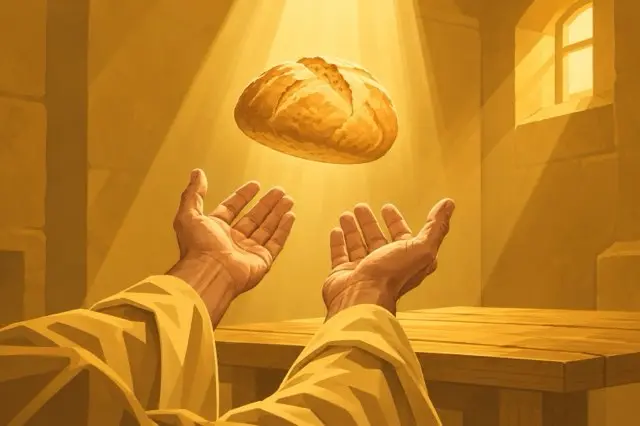
Give us this day our daily bread
and forgive us our trespasses
as we forgive those who trespass against us;
and lead us not into temptation,
but deliver us from evil.
Amen.
Why This Prayer Matters
Jesus's disciples watched Him pray for months, on mountains, in gardens, before crowds, alone at dawn. They saw what prayer did to Him and through Him. Finally they asked: "Lord, teach us to pray." He gave them seven petitions in about thirty seconds. Two thousand years later, those words are still the most prayed sentences in human history. Every Christian tradition on earth, Catholic, Orthodox, Protestant, prays this prayer. It has been whispered in prison cells, shouted on battlefields, murmured in hospitals, and sung in cathedrals. It is the one prayer Jesus Himself composed, the one prayer that belongs to every Christian who has ever lived.
The Story Behind the Prayer
The Disciples' Request
The scene is Galilee, or perhaps the road to Jerusalem, Luke's Gospel places the moment after Jesus had been praying alone, and His disciples approached Him:
"And it happened that, while he was praying in a certain place, after he had finished, one of his disciples said to him, 'Lord, teach us to pray, just as John also taught his disciples.'", Luke 11:1
What had they seen in His face when He finished? What was different about the way Jesus prayed that made them hunger for it? Whatever it was, Jesus didn't give them a technique. He gave them words, specific, concrete, revolutionary words.
A Prayer Unlike Any Other
In Matthew's Gospel, the Our Father appears in the Sermon on the Mount, nestled between warnings against showy prayer and instructions about fasting. Jesus contrasts His prayer with the "babbling" of pagans who think God is impressed by many words. Instead, He offers brevity and depth, seven petitions that encompass everything a human being could ever need to say to God.
The opening word alone was revolutionary. Jews addressed God as "Lord," "King," "Almighty." Jesus said Abba, Father. Not distant sovereign, but intimate parent. He then invited His followers to share that intimacy: "Our Father." Not "my", ours. This prayer is never prayed alone, even when spoken in solitude, because it binds every Christian to every other.
From the Gospels to the World
The Our Father entered Christian worship immediately. The Didache, one of the earliest Christian documents (c. 70-100 AD), instructed believers to pray it three times daily. By the fourth century, it was the centerpiece of the catechetical process, the prayer handed over to new converts just before baptism as the family prayer they were now privileged to share. St. Augustine called it "a summary of the whole Gospel." Tertullian called it "the epitome of the entire Gospel."
It has been translated into every language where Christianity has taken root. Its words have been set to music by Bach, Mozart, and countless anonymous monks chanting in candlelit chapels. It remains the one prayer that unites all Christians across every division.
What This Prayer Means
The Our Father moves in a deliberate arc, from God's glory to human need. The first three petitions look upward: may Your name be revered, may Your kingdom come, may Your will be accomplished. Only then does the prayer turn to us: give us bread, forgive us, protect us. The structure itself teaches us how to pray, God first, then ourselves.
"Give us this day our daily bread" is the prayer's hinge. It grounds the cosmic petitions in the utterly ordinary. The God whose kingdom is coming is also the God who cares whether you eat today. Grace is not just eternal destiny, it is Tuesday's lunch.
The most demanding line comes in the middle: "forgive us our trespasses as we forgive those who trespass against us." This is the only petition with a condition. Jesus ties our experience of God's mercy to our willingness to extend it. The prayer doesn't let us receive forgiveness while hoarding resentment.
Why It Matters Today
The Living Practice
The Our Father is prayed at every Mass, in every decade of the Rosary, and in every hour of the Liturgy of the Hours. It is the prayer Christians reach for when they don't know what to say, in hospital rooms, at gravesides, in moments of terror or gratitude. It is the prayer parents teach first, and the prayer the dying whisper last.
Its universality is its power. When you pray the Our Father, you join every Christian on earth who is praying those same words in a thousand languages at that same moment. It is the prayer that makes visible what the communion of saints actually means.
Lessons for Us
1. God is Father first: Before He is judge, king, or creator, He is Father. The Our Father teaches us to approach God with the trust of a child, not the anxiety of a subject.
2. Forgiveness is non-negotiable: The prayer conditions God's forgiveness on ours. You cannot honestly pray "forgive us as we forgive" while refusing to forgive someone in your life.
3. Daily bread, not yearly reserves: The prayer asks for today's bread, not tomorrow's security. It teaches dependence, trust, and the freedom of not needing to control the future.
4. Prayer is communal: "Our" Father, "our" daily bread, "our" trespasses. Even in private prayer, we pray as members of a family, never as isolated individuals.
Quick Facts
- Also Known As: Lord's Prayer, Pater Noster, The Prayer
- Origin: Taught by Jesus Christ, c. 30 AD
- Category: Foundational Prayer
- Scripture Basis: Matthew 6:9-13; Luke 11:2-4
- Liturgical Use: Every Mass (Liturgy of the Eucharist), Liturgy of the Hours, Rosary
- When to Pray: Daily prayer, morning/evening, before meals, in every circumstance
Going Deeper
Scripture References
- Direct Source: Matthew 6:9-13 (Sermon on the Mount); Luke 11:2-4 (after Jesus prays)
- Context: Matthew 6:5-8, Jesus's instructions on how to pray
- Thematic Connections: Matthew 7:7-11, ask, seek, knock; Romans 8:15, the Spirit of adoption crying "Abba, Father"
Church Teaching
- Catechism: CCC 2759-2865, the entire final section of the Catechism is a commentary on the Our Father
- St. Augustine: "Run through all the words of holy prayer, and I do not think you will find anything which is not contained and included in the Lord's Prayer."
- Tertullian: "In the Lord's Prayer is comprised an epitome of the entire Gospel."
Historical Timeline
- c. 30 AD: Jesus teaches the prayer to His disciples
- c. 70-100 AD: The Didache prescribes praying it three times daily
- 4th century: Becomes central to baptismal catechesis; given to catechumens before baptism
- 6th century: Pope Gregory the Great places it directly before Communion in the Roman Mass
- 2002: Pope John Paul II adds the Luminous Mysteries to the Rosary, each decade framed by the Our Father
Keep exploring in the app
The Bible, the map, the timeline and the whole library, in one place.
Open the app