The Rosary
What is the Rosary?
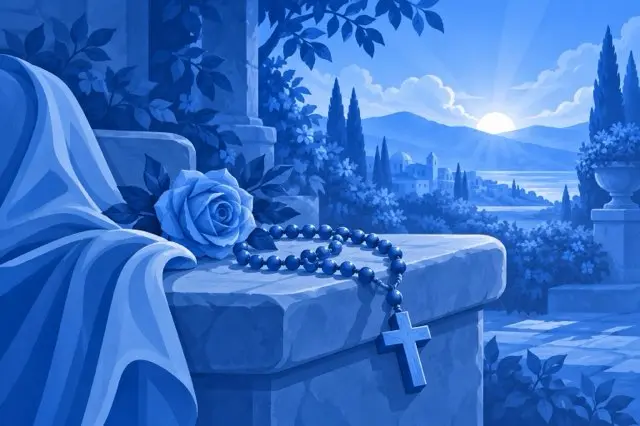
The Rosary is a meditative prayer that reflects on the central mysteries of the life of Jesus and Mary while praying familiar words on a string of beads. Through its rhythm of Our Fathers, Hail Marys, and Glory Bes, the believer contemplates the Gospel with Mary at their side. Among the most beloved Catholic devotions, it has steadied and consoled the faithful for centuries.
- Role
- Marian devotion
- Also Known As
- The Holy Rosary, The Dominican Rosary, The Most Holy Rosary
- Origin
- Developed 12th-15th centuries; standardized by Pope Pius V in 1569; Luminous Mysteries added by Pope John Paul II in 2002
- Category
- Marian Devotion / Contemplative Prayer
- Scripture Basis
- All 20 Mysteries are drawn from the Gospels; Luke 1-2 (Joyful); Passion narratives (Sorrowful); Acts 1-2 (Glorious)
- Liturgical Use
- Personal and communal devotion; October is the Month of the Rosary
- When to Pray
- Daily devotion, family prayer, difficult times, seeking Mary's intercession
- Key Scripture
- Luke 1, Luke 1-2, Acts 1-2
More in the app
The people, places and passages behind it, in one place.
Explore The Rosary in the appWhy This Prayer Matters
It is the most misunderstood prayer in Christianity and the most beloved devotion in Catholicism. Critics see repetition, the same words said fifty, a hundred, a hundred and fifty times. Those who pray it see something else entirely: a rhythm that quiets the mind so the heart can contemplate the life of Christ. The Rosary is not about the words. It is about the mysteries, twenty scenes from the Gospel, from the Annunciation to the Coronation of Mary, meditated upon while the hands move beads and the lips pray Hail Marys. Popes have credited it with turning the tide of battles. Saints have called it the weapon against every spiritual assault. Ordinary Catholics have found in it a contemplative prayer accessible to anyone who can count to ten.
The Story Behind the Prayer
From Psalms to Roses
The Rosary did not arrive fully formed. It grew from centuries of prayer. In the early Middle Ages, lay Christians who could not read the Latin Psalter began reciting 150 Our Fathers or Hail Marys as a substitute for the 150 Psalms monks chanted daily. They used strings of beads to count, and these bead-strings became known as "rosaries," from the Latin rosarium (rose garden), because each prayer was imagined as a rose offered to Mary.
By the twelfth century, the practice had evolved from raw repetition to structured meditation. Preachers began pairing the Hail Marys with scenes from the life of Christ and Mary, giving the repetitive prayer a contemplative depth it had previously lacked. The beads counted the prayers. The mind dwelt on the Gospel.
St. Dominic and the Legend
Tradition credits St. Dominic (1170-1221) with receiving the Rosary directly from Mary in a vision. Historical evidence suggests the story is a later attribution, but what is undeniable is that Dominican friars were instrumental in promoting and popularizing the Rosary across Europe. Alan de la Roche, a fifteenth-century Dominican, established Rosary confraternities that spread the devotion to millions.
Lepanto and the Power of the Rosary
On October 7, 1571, a Christian fleet faced a vastly superior Ottoman navy at the Battle of Lepanto. Pope Pius V asked all of Christendom to pray the Rosary for victory. Against all expectation, the Christian fleet won decisively. Pius V attributed the victory to the Rosary and established the Feast of Our Lady of the Rosary on October 7, a feast still celebrated today.
Whether or not the Rosary "caused" the victory at Lepanto, the event cemented the devotion's place in Catholic identity. The Rosary was no longer just a private prayer. It was the Church's great communal weapon, the prayer that moved heaven.
The Luminous Mysteries
For nearly five hundred years, the Rosary had three sets of mysteries: Joyful, Sorrowful, and Glorious. In 2002, Pope John Paul II added a fourth set, the Luminous Mysteries, focusing on key moments of Jesus's public ministry: His baptism, the wedding at Cana, the proclamation of the Kingdom, the Transfiguration, and the institution of the Eucharist. The addition filled a notable gap, bringing the Rosary's meditation through the full arc of Christ's life.
What This Prayer Means
The Rosary is, at its core, a Gospel meditation. The repetitive prayers, Our Father, Hail Mary, Glory Be, create a rhythm that occupies the surface of the mind while the deeper attention rests on the mystery. It is the same principle as a musical ostinato: a repeating pattern that frees the listener to hear the melody above it.
Each set of mysteries traces a different movement of salvation. The Joyful Mysteries celebrate the Incarnation, God entering human life as a child. The Luminous Mysteries illuminate Christ's public ministry, His teaching, His signs, His revelation. The Sorrowful Mysteries confront the passion, suffering, blood, death. The Glorious Mysteries proclaim the victory, resurrection, ascension, the Spirit's coming, and Mary's exaltation.
Together, the twenty mysteries form a complete Gospel narrative prayed through Mary's eyes. The Rosary asks: What did Mary see? What did she remember? How did she hold these things in her heart?
Why We Say What We Say, in the Order We Do
The order of the Rosary is not arbitrary. It is built to carry you from "I believe" all the way to "Glory," and to keep Christ at the center the whole way through.
You begin with the Sign of the Cross and the Apostles' Creed, because you start by saying what you believe. You plant your feet. Then an Our Father, three Hail Marys, and a Glory Be, a small porch you step through before entering the house. Those three Hail Marys are traditionally prayed for an increase of faith, hope, and love, the three things you will need to pray well.
Then come the five decades, and each one has the same shape for a reason. First the mystery is announced, the scene you are about to live inside. Then the Our Father, because Jesus himself taught that prayer, and it turns the whole decade toward the Father before anything else is said. Then ten Hail Marys, and this is the part most often misunderstood. The repetition is not ten messages fired at Mary. It is a rhythm, almost like a heartbeat or the sound of waves, that quiets the busy front of the mind so the deeper attention can rest on the scene. The words themselves come straight from Scripture: the angel Gabriel's greeting at the Annunciation in Luke 1 and Elizabeth's words at the Visitation in Luke 1, with the Church's own plea added at the end, asking the Mother of God to pray for us now and at the hour of our death. So while the lips carry that gentle, familiar prayer, the heart is free to watch Jesus being born, or carrying his cross, or rising. Mary is not the destination. She is the one holding your hand and pointing, exactly as she did at the wedding at Cana when she said, "Do whatever he tells you." Every Hail Mary, in a sense, is her saying that again: look at him.
Each decade then closes with the Glory Be, praise to the Father, Son, and Holy Spirit, so that every ten beads ends not in asking but in adoration. After the five decades you close the whole Rosary with the Salve Regina and a final prayer. You walked in saying "I believe." You walk out saying "Glory."
The Words: Decade and Mystery
Two words in the Rosary can quietly trip up newcomers, and both are worth slowing down on.
A decade simply means a set of ten, from the old root for ten, the same one beneath the "Decalogue," the Ten Commandments. A decade of the Rosary is its ten Hail Marys, fenced on one side by the Our Father that opens it and on the other by the Glory Be that closes it. Five of those decades make a full Rosary. Three sets of five once made the original hundred and fifty, mirroring the hundred and fifty Psalms. (The word "bead," for that matter, comes from an old English word that simply meant "prayer.")
A mystery is the deeper word, and it does not mean what it means in ordinary English. It is not a puzzle or a riddle, something to be solved and then set aside. It comes from a Greek word, mysterion, which Saint Paul uses for God's saving plan, hidden for ages and now revealed in Christ. A mystery in this sense is not something you cannot understand. It is something so full of God that you can never finish understanding it. You do not solve it; you enter it, and you can return to it your whole life and always find more. So each mystery of the Rosary is a real moment in the life of Jesus and Mary, the Annunciation, the Nativity, the Crucifixion, the Resurrection, that you do not merely recall but step inside and contemplate.
Why It Matters Today
The Living Practice
The Rosary is prayed in parish groups, in families, on commutes, in hospital rooms, and in prison cells. It requires no book, no building, no priest, only beads (or fingers) and a willing heart. Its accessibility is its genius: the most contemplative prayer in the Catholic tradition is available to anyone, anywhere, at any time.
October is the Month of the Rosary. May, the Month of Mary, is also closely associated with Rosary devotion. Many Catholic families pray the Rosary together, often in the evening, a practice that has shaped household spirituality for centuries.
For those new to contemplative prayer, the Rosary offers a structured entry point. The beads give the hands something to do. The familiar words give the lips something to say. And in the quiet beneath the rhythm, the mysteries of Christ's life begin to speak.
Lessons for Us
1. Repetition is not vain: Jesus warned against "babbling", but the Rosary's repetition is not empty. It is the rhythm that enables contemplation, like the steady breath that enables meditation.
2. The Gospel is meant to be lived in: The mysteries invite us not just to know the Gospel but to enter it, to stand at the manger, to kneel at the cross, to witness the empty tomb.
3. Prayer is a practice: The Rosary rewards consistency. Prayed once, it is pleasant. Prayed daily for years, it becomes a window into the life of Christ that opens wider with every repetition.
4. Mary leads to Jesus: Every Hail Mary names Jesus, "blessed is the fruit of thy womb, Jesus." The Rosary is Marian in form and Christological in substance. Mary's role is to point toward her Son.
Quick Facts
- Also Known As: The Holy Rosary, The Dominican Rosary, The Most Holy Rosary
- Origin: Developed 12th-15th centuries; standardized by Pope Pius V in 1569; Luminous Mysteries added by Pope John Paul II in 2002
- Category: Marian Devotion / Contemplative Prayer
- Scripture Basis: All 20 Mysteries are drawn from the Gospels; Luke 1-2 (Joyful); Passion narratives (Sorrowful); Acts 1-2 (Glorious)
- Liturgical Use: Personal and communal devotion; October is the Month of the Rosary
- When to Pray: Daily devotion, family prayer, difficult times, seeking Mary's intercession
Going Deeper
Scripture References
Joyful Mysteries:
- Annunciation: Luke 1:26-38
- Visitation: Luke 1:39-56
- Nativity: Luke 2:1-20
- Presentation: Luke 2:22-40
- Finding in the Temple: Luke 2:41-52
Sorrowful Mysteries:
- Agony in the Garden: Matthew 26:36-46
- Scourging: John 19:1
- Crowning with Thorns: Matthew 27:27-31
- Carrying the Cross: John 19:17
- Crucifixion: John 19:25-30
Glorious Mysteries:
- Resurrection: Matthew 28:1-10
- Ascension: Luke 24:50-53
- Descent of the Holy Spirit: Acts 2:1-13
- Assumption: Tradition; Revelation 12:1
- Coronation: Tradition; Revelation 12:1
Luminous Mysteries:
- Baptism of Jesus: Matthew 3:13-17
- Wedding at Cana: John 2:1-12
- Proclamation of the Kingdom: Mark 1:14-15
- Transfiguration: Matthew 17:1-8
- Institution of the Eucharist: Luke 22:14-20
Church Teaching
- Catechism: CCC 2678, "Medieval piety in the West developed the prayer of the rosary as a popular substitute for the Liturgy of the Hours."
- Pope Pius V (1569): Standardized the Rosary and attributed the victory at Lepanto to its intercession
- Pope John Paul II (2002): Added the Luminous Mysteries in Rosarium Virginis Mariae, calling the Rosary "a compendium of the Gospel"
- Pope Paul VI: "The Rosary is a Gospel prayer... centered on the mystery of the redemptive Incarnation"
Historical Timeline
- 12th century: Practice of 150 Hail Marys with beads develops
- 13th century: Dominican friars promote structured Rosary with mysteries
- 1569: Pope Pius V standardizes the Rosary in current form
- 1571: Battle of Lepanto; Feast of Our Lady of the Rosary established (October 7)
- 2002: Pope John Paul II adds the Luminous Mysteries
Keep exploring in the app
The Bible, the map, the timeline and the whole library, in one place.
Open the app