Hail Mary
What is the Hail Mary?
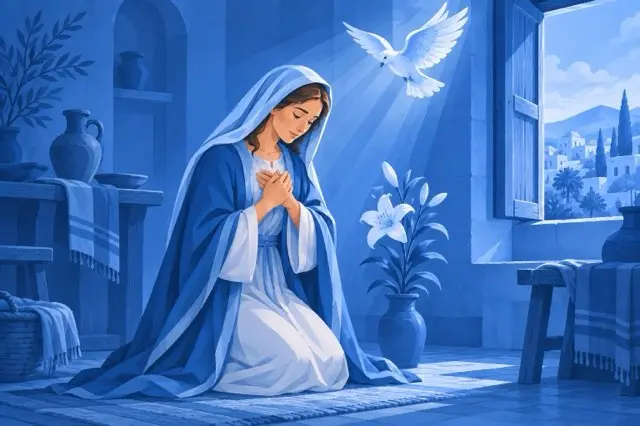
Hail Mary is a Marian devotion that joins the angel Gabriel's greeting and Elizabeth's blessing with a humble plea for Mary's prayers. The Hail Mary, known in Latin as the Ave Maria, joins the angel Gabriel's greeting and Elizabeth's blessing of Mary with a humble plea for her prayers. It forms the heart of the Rosary and is among the most beloved prayers in Christian devotion. Through it the faithful ask the Mother of Jesus to intercede for them, now and at the hour of death.
- Role
- Marian devotion
- Also Known As
- Ave Maria, The Angelic Salutation
- Origin
- Biblical words (1st century); full form codified by Pope Pius V in 1568
- Category
- Marian Prayer
- Scripture Basis
- Luke 1:28 (Gabriel's greeting); Luke 1:42 (Elizabeth's blessing)
- Liturgical Use
- Rosary (50+ repetitions), Angelus, all Marian devotions
- When to Pray
- Daily devotion, Rosary, seeking intercession, morning/evening, in danger
- Key Scripture
- Luke 1:28, Luke 1:42
More in the app
The people, places and passages behind it, in one place.
Explore Hail Mary in the appThe Prayer
Hail Mary,
full of grace,
the Lord is with thee.
Blessed art thou among women,
and blessed is the fruit of thy womb, Jesus.
Holy Mary,
Mother of God,
pray for us sinners,
now and at the hour of our death.
Amen.
Why This Prayer Matters
In the sixth month of Elizabeth's pregnancy, God sent an angel to a young woman in Nazareth. The angel's greeting, "Hail, full of grace", became the opening of what is now the most repeated prayer in Catholic devotion. Prayed over fifty times in a single Rosary, whispered in moments of fear, sung in cathedrals, and clutched on deathbeds, the Hail Mary is woven from two moments of Scripture and one great petition of the Church. Half of it is God's word to Mary through Gabriel and Elizabeth. The other half is humanity's word back, asking the woman who said "yes" to the Incarnation to pray for us at the two moments that matter most: now, and at the hour of our death.
The Story Behind the Prayer
The Annunciation
The first words of the Hail Mary are not human words at all. They are the Angel Gabriel's greeting to a teenage girl in a backwater town of Roman-occupied Palestine:
"And upon entering, the Angel said to her: 'Hail, full of grace. The Lord is with you. Blessed are you among women.'", Luke 1:28
"Full of grace", gratia plena, was not a compliment. It was a title. Gabriel was announcing what God had done in Mary: filled her with grace, prepared her for the most extraordinary vocation in human history. She would carry the Son of God in her womb. The Creator of the universe would be nursed at her breast.
Mary's response was not serene acceptance. Luke records that she was "greatly troubled" and "considered what sort of greeting this might be." She questioned. She pondered. And then she said the words that changed everything: "Be it done to me according to your word." The Incarnation hinged on her yes.
The Visitation
Mary traveled to the hill country of Judea to visit her cousin Elizabeth, who was six months pregnant with John the Baptist. The moment Mary's greeting reached Elizabeth's ears, the baby leaped in her womb, and Elizabeth cried out:
“Blessed are you among women, and blessed is the fruit of your womb.”, Luke 1:42
These Spirit-filled words became the second line of the Hail Mary. Elizabeth recognized what was happening, that the mother of her Lord had come to her, and her exclamation joined Gabriel's greeting to form the biblical half of the prayer.
The Church Adds Its Voice
For centuries, Christians prayed only these scriptural words, Gabriel's greeting joined to Elizabeth's blessing. The prayer was a meditation on the Incarnation, not a petition. It was the Church simply repeating what Scripture said about Mary.
The second half, "Holy Mary, Mother of God, pray for us sinners, now and at the hour of our death", developed gradually during the medieval period and was formally codified by Pope Pius V in 1568. The title "Mother of God" (Theotokos) had been defined at the Council of Ephesus in 431 AD. The petition reflects the Church's growing understanding of Mary's intercessory role, that the woman closest to Christ in life remains closest to His people in prayer.
What This Prayer Means
The Hail Mary is two movements in one prayer. The first half is praise, recalling what God has done. It echoes the Gospel itself: the angel's announcement, the cousin's recognition, the miracle of God becoming flesh. To pray "Hail Mary, full of grace" is to stand in Gabriel's place and marvel at what God accomplished in this woman.
The second half is petition, and it is startlingly honest. "Pray for us sinners", no pretense, no qualification. We come as sinners. And we ask for prayer at two specific moments: "now", whatever crisis or ordinary Tuesday we are living, and "at the hour of our death", the moment when everything else falls away and only God's mercy matters.
The name "Jesus" stands at the center of the prayer, the hinge between praise and petition. The Hail Mary is, at its heart, a prayer about Christ, the fruit of Mary's womb, the reason she matters, the one to whom her intercession is directed.
Why It Matters Today
The Living Practice
The Hail Mary is the heartbeat of the Rosary, repeated over fifty times in a full recitation, its rhythm becoming meditative, almost breathing. But it lives far beyond the Rosary. Catholics pray it at the Angelus three times a day. Parents teach it as a first prayer. The dying hear it whispered in their final moments.
For many Catholics, the Hail Mary is the prayer of instinct, the one that rises automatically in danger, in gratitude, in the quiet of a sleepless night. Its familiarity is not a weakness but a strength. Like a heartbeat, it works best when it doesn't need to be thought about, when it has become part of the rhythm of life.
Lessons for Us
1. Scripture is prayer: The first half of the Hail Mary is pure Gospel. Praying it is praying Scripture, letting God's own words become our words back to Him.
2. Honesty before God: "Pray for us sinners" does not hedge. It names what we are. The Hail Mary teaches us that approaching God begins with truthfulness, not self-improvement.
3. Every moment matters: "Now and at the hour of our death", the prayer collapses time into two points. It teaches us that the present moment and the final moment are the only ones we can actually inhabit.
Quick Facts
- Also Known As: Ave Maria, The Angelic Salutation
- Origin: Biblical words (1st century); full form codified by Pope Pius V in 1568
- Category: Marian Prayer
- Scripture Basis: Luke 1:28 (Gabriel's greeting); Luke 1:42 (Elizabeth's blessing)
- Liturgical Use: Rosary (50+ repetitions), Angelus, all Marian devotions
- When to Pray: Daily devotion, Rosary, seeking intercession, morning/evening, in danger
Going Deeper
Scripture References
- Direct Source: Luke 1:28, Gabriel's greeting; Luke 1:42, Elizabeth's exclamation
- The Annunciation: Luke 1:26-38, the full scene
- The Visitation: Luke 1:39-56, Mary visits Elizabeth
- Thematic: Luke 1:46-55, the Magnificat, Mary's own prayer of praise
Church Teaching
- Council of Ephesus (431 AD): Defined Mary as Theotokos (Mother of God), the theological foundation for the prayer's title
- Catechism: CCC 2676-2677, "In asking Mary to pray for us, we acknowledge ourselves to be poor sinners and we address ourselves to the 'Mother of Mercy.'"
- St. Louis de Montfort: "The Hail Mary is the most beautiful prayer after the Our Father. It is the most perfect compliment that you can offer to Mary."
Historical Timeline
- c. 30 AD: Gabriel greets Mary; Elizabeth blesses her
- 4th-5th century: Christians begin praying Gabriel's greeting as devotion
- 431 AD: Council of Ephesus defines Mary as Theotokos (Mother of God)
- 13th century: The petition "Holy Mary, Mother of God..." begins to appear
- 1568: Pope Pius V codifies the full Hail Mary in the Roman Breviary
Keep exploring in the app
The Bible, the map, the timeline and the whole library, in one place.
Open the app