Jerusalem
What is Jerusalem in the Bible?
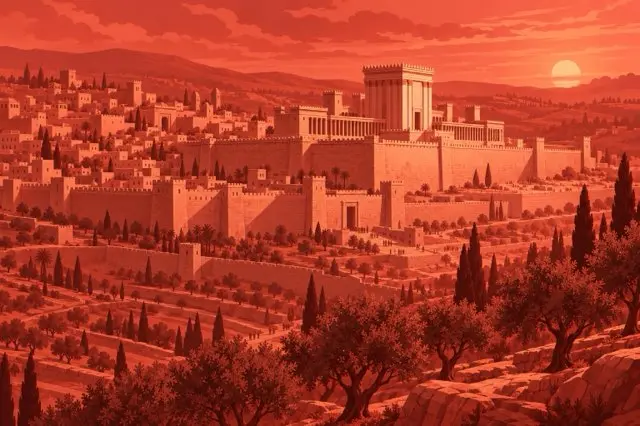
Jerusalem is the holy city set on the hills of Judea, home to the Temple and the center of Jewish worship. Jesus taught in its courts, celebrated the Last Supper here, and was crucified and raised just outside its walls. It was here that the Holy Spirit descended at Pentecost and the Church was born.
- Role
- Holy city of Judea
- Name Meaning
- "Foundation of Peace" or "City of Peace" (Hebrew: Yerushalayim)
- Also Known As
- Zion, City of David, Holy City, Salem
- Location
- Central Judean hills, ~2,500 feet elevation
- First-Century Population
- 40,000-80,000 (swelling to 250,000+ during festivals)
- Political Status
- Under Roman rule, governed by prefect (Pontius Pilate)
- Religious Status
- Center of Jewish worship; site of Herod's Temple
- Key Scripture
- Luke 19:41-44, Luke 24:46-49, Acts 2:1-4
More in the app
The people, places and passages behind it, in one place.
Explore Jerusalem in the appWhy This Place Matters
Every road in the Gospel leads to Jerusalem. Here the Temple rose above the ancient hills, God's chosen dwelling among His people. Here Jesus wept over a city that did not recognize its visitation. Here He was arrested in an olive garden, tried by Rome and religion alike, and crucified on a skull-shaped hill outside the walls. Here the tomb was found empty. Here the Spirit fell at Pentecost and the Church was born. No city in Scripture carries more weight. Jerusalem is the stage where salvation's drama reached its climax.
The Setting
Jerusalem sits on a rocky plateau in the Judean highlands, surrounded by deep valleys on three sides:
Geography:
- Kidron Valley: East, between city and Mount of Olives
- Hinnom Valley: South and west
- Central Valley: Divided upper and lower city
- Water source: Gihon Spring, supplemented by aqueducts and cisterns
City Layout in Jesus's Time:
| Area | Character |
|---|---|
| Temple Mount | 35-acre platform dominating the northeast; Herod's Temple at center |
| Upper City | Wealthy neighborhood; palatial homes; likely site of Upper Room |
| Lower City | Poorer neighborhoods; Pool of Siloam at southern end |
| Fortress Antonia | Roman garrison overlooking Temple; possible site of Jesus's trial |
Historical Background
| Period | Significance |
|---|---|
| Canaanite | Called "Salem", Melchizedek was king (Genesis 14:18) |
| Jebusite | Fortress city until David conquered it (~1000 BC) |
| David | Made it his capital; brought the Ark of the Covenant |
| Solomon | Built the First Temple (~960 BC) |
| 587 BC | Babylonians destroyed Temple; exile began |
| 516 BC | Second Temple built under Zerubbabel |
| 63 BC | Rome conquered Jerusalem under Pompey |
| 37-4 BC | Herod the Great's reign; massive Temple expansion |
In Jesus's Time
Political Reality:
- Under Roman occupation since 63 BC
- Jewish Sanhedrin had limited authority (could not execute)
- Roman garrison stationed in Fortress Antonia
- Tensions high, especially during festivals
Religious Significance:
- The Temple was the only place for sacrifice
- Three pilgrimage festivals drew Jews from across the world
- Center of Sadducean power (Temple aristocracy)
- High priest was most powerful Jewish figure
Herod the Great's Temple:
The Temple was one of the ancient world's wonders, a massive complex of courts, colonnades, and the sanctuary itself:
1. Court of the Gentiles, Open to all; money changers operated here
2. Soreg, Low wall forbidding Gentiles to proceed further
3. Court of Women, Jewish women could enter this far
4. Court of Israel, Jewish men's area
5. Court of Priests, Where sacrifices were performed
6. The Sanctuary, Holy Place and Holy of Holies
In the Gospel Story
Jesus's Relationship to Jerusalem
Jesus's life moved decisively toward this city:
| Phase | Significance |
|---|---|
| Presentation (Luke 2) | First brought to Temple as infant |
| Age 12 (Luke 2:41-52) | "I must be in my Father's house" |
| Festival visits (John 2, 5, 7, 10) | Multiple visits recorded in John |
| Final journey | "He set his face to go to Jerusalem" (Luke 9:51) |
| Passion and Death | Arrested, tried, crucified |
| Resurrection | Rose from tomb just outside walls |
| Ascension | From Mount of Olives (Acts 1) |
| Pentecost | Spirit descended; Church born (Acts 2) |
The Final Week
Palm Sunday: Jesus entered from Mount of Olives through eastern gate. Crowds proclaimed Him king. Fulfilled Zechariah 9:9.
Temple Cleansing: Drove out money changers. "My house shall be called a house of prayer, but you have made it a den of robbers."
Teaching: Parables and debates with religious leaders. Widow's mite. Olivet Discourse prophesying Temple's destruction.
Last Supper: Upper Room. Institution of the Eucharist. Washing of feet.
Gethsemane: Garden on Mount of Olives. Jesus's agony and arrest.
Trials: Before Annas, Caiaphas, Sanhedrin, Pilate, Herod Antipas, then Pilate again.
Crucifixion: Golgotha, "Place of the Skull," outside city walls. Death between two criminals.
Resurrection: Empty tomb. Appearances to disciples. "Beginning from Jerusalem" (Luke 24:47).
Pentecost: Spirit descended. Peter's sermon. 3,000 baptized. Church born.
Theological Significance
Old Testament Themes
1. God's Chosen Dwelling: "The LORD has chosen Zion; he has desired it for his dwelling place" (Psalm 132:13)
2. City of the Great King: "Great is the LORD, and greatly to be praised in the city of our God" (Psalm 48:1)
3. Pilgrimage Destination: "I was glad when they said to me, 'Let us go to the house of the LORD'" (Psalm 122:1)
New Testament Fulfillment
1. Jesus as the New Temple: "Destroy this temple, and in three days I will raise it up" (John 2:19). His body is the true dwelling of God.
2. Jerusalem Rejected Her King: "O Jerusalem, Jerusalem, the city that kills the prophets" (Matthew 23:37). Jesus wept over the city.
3. Prophecy of Destruction: "Not one stone here will be left on another" (Matthew 24:2). Fulfilled in AD 70.
4. The Heavenly Jerusalem: "The Jerusalem above is free, and she is our mother" (Galatians 4:26). "The holy city, new Jerusalem, coming down out of heaven from God" (Revelation 21:2).
Quick Facts
- Name Meaning: "Foundation of Peace" or "City of Peace" (Hebrew: Yerushalayim)
- Also Known As: Zion, City of David, Holy City, Salem
- Location: Central Judean hills, ~2,500 feet elevation
- First-Century Population: 40,000-80,000 (swelling to 250,000+ during festivals)
- Political Status: Under Roman rule, governed by prefect (Pontius Pilate)
- Religious Status: Center of Jewish worship; site of Herod's Temple
Scripture References
Key Passages
| Event | Reference |
|---|---|
| Presentation | Luke 2:22-38 |
| Boy Jesus in Temple | Luke 2:41-52 |
| First Cleansing | John 2:13-22 |
| Pool of Bethesda healing | John 5:1-18 |
| Feast of Tabernacles | John 7-8 |
| Man born blind | John 9 |
| Triumphal Entry | Matthew 21:1-11; Mark 11; Luke 19; John 12 |
| Second Cleansing | Matthew 21:12-17 |
| Olivet Discourse | Matthew 24-25; Mark 13; Luke 21 |
| Last Supper | Matthew 26; Mark 14; Luke 22; John 13-17 |
| Gethsemane | Matthew 26:36-46; Mark 14:32-42; Luke 22:39-46 |
| Trials and Crucifixion | All four Gospels |
| Resurrection | All four Gospels |
| Ascension | Luke 24:50-53; Acts 1:6-12 |
| Pentecost | Acts 2 |
Keep exploring in the app
The Bible, the map, the timeline and the whole library, in one place.
Open the app