Peter
What does the Bible say about Peter?
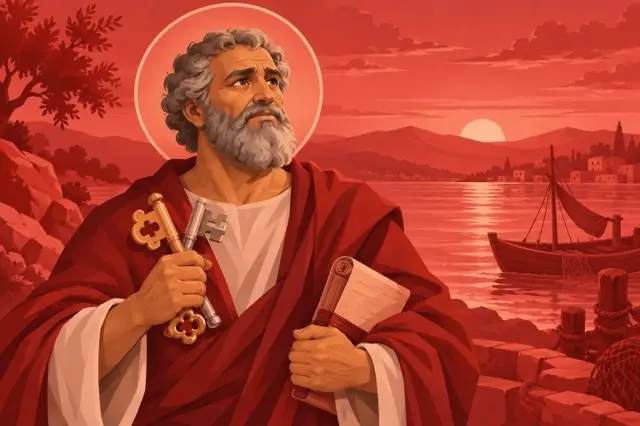
Peter is the Galilean fisherman whom Jesus called and who became the leader and spokesman of the Twelve Apostles. A Galilean fisherman whom Jesus called to follow him, Peter became the leader and spokesman of the Twelve Apostles. Jesus gave him the new name Cephas, meaning rock, and entrusted him with the keys of the kingdom. Though he denied Jesus three times during the Passion, he was restored and went on to shepherd the early Church.
- Role
- Leader of the Twelve Apostles
- Also Known As
- Simon, Cephas, Simon Bar-Jonah, Simon Peter
- From
- Bethsaida, later Capernaum
- Background
- Fisherman
- Key Scripture
- Matthew 16:16-19, John 21:15-17, Luke 22:54-62
Who Was Peter?
He swore he would die for Jesus, then denied knowing Him three times before dawn. Yet this same man who cowered before a servant girl's accusation would stand before thousands at Pentecost and boldly proclaim the resurrection. Peter's story is the ultimate tale of failure transformed into faithfulness, of a man whose greatest weakness became the foundation for his greatest strength.
His Story
Peter was a fisherman working the waters of Galilee when Jesus called him to a different kind of catch. "Follow me," Jesus said, "and I will make you fishers of men." Peter left his nets immediately, a pattern of impulsive devotion that would define his relationship with Christ.
The Rock and the Rebuke
At Caesarea Philippi, Peter made the confession that would define his legacy:
"Simon Peter responded by saying, “You are the Christ, the Son of the living God.”" (Matthew 16:16)
Jesus responded with a new name and a stunning promise:
"And I say to you, that you are Peter, and upon this rock I will build my Church, and the gates of Hell shall not prevail against it." (Matthew 16:18)
Yet moments later, when Jesus spoke of His coming death, Peter rebuked Him, and received the sharpest correction in the Gospels: "Get behind me, Satan!" The rock could also be a stumbling block.
Walking on Water
When the disciples saw Jesus walking on the sea, Peter did what no one else dared:
"Then Peter responded by saying, “Lord, if it is you, order me to come to you over the waters.”" (Matthew 14:28)
He stepped out of the boat. He walked on water. Then he saw the wind, felt fear, and began to sink. "Lord, save me!" he cried, and Jesus caught him. It's the perfect picture of Peter: bold enough to step out, human enough to falter, wise enough to cry for help.
The Denial
At the Last Supper, Peter declared he would die with Jesus. Hours later, in the courtyard of the high priest, he denied knowing Him, not to soldiers or authorities, but to a servant girl. Three times he denied, and then the rooster crowed.
"And going out, Peter wept bitterly." (Luke 22:62)
The Restoration
After the resurrection, Jesus found Peter by the same sea where He had first called him. Three times Jesus asked, "Do you love me?", one question for each denial. Three times Peter affirmed his love. Three times Jesus commissioned him:
"Then, when they had dined, Jesus said to Simon Peter, “Simon, son of John, do you love me more than these?” He said to him, “Yes, Lord, you know that I love you.” He said to him, “Feed my lambs.” He said to him again: “Simon, son of John, do you love me?” He said to him, “Yes, Lord, you know that I love you.” He said to him, “Feed my lambs.” He said to him a third time, “Simon, son of John, do you love me?” Peter was very grieved that he had asked him a third time, “Do you love me?” And so he said to him: “Lord, you know all things. You know that I love you.” He said to him, “Feed my sheep." (John 21:15-17)
The man who denied Christ three times was restored with three affirmations of love and purpose.
Pentecost and Beyond
Fifty days after the resurrection, the Holy Spirit descended. Peter, the same man who had hidden in fear, stood before thousands in Jerusalem and preached with power. Three thousand were saved that day. The denier became the proclaimer.
Peter went on to lead the early church, receive the vision that opened the Gospel to Gentiles, write two New Testament letters, and ultimately give his life for the faith he once denied.
In His Own Words
"Simon Peter answered him: "Lord, to whom would we go? You have the words of eternal life."", John 6:69
"Simon Peter responded by saying, “You are the Christ, the Son of the living God.”", Matthew 16:16
"Peter said to him, “Even if it is necessary for me to die with you, I will not deny you.” And all the disciples spoke similarly.", Matthew 26:35
What Happened to Him?
According to tradition, Peter was crucified in Rome under Emperor Nero around 64-68 AD. He reportedly requested to be crucified upside down, feeling unworthy to die in the same manner as his Lord. The man who once denied Christ chose a death that proclaimed Him.
Catholic tradition recognizes Peter as the first Pope, and St. Peter's Basilica in Rome is built over his traditional burial site. His legacy extends through centuries of Church leadership that traces its authority to his commission.
Why He Matters Today
The Transformation
Before: Impulsive fisherman who spoke before thinking, acted on emotion, and feared human opinion enough to deny Christ three times.
After: Spirit-empowered leader who preached boldly before thousands, faced persecution without flinching, and willingly died for the faith he once denied.
The same personality traits remained, Peter was always passionate, always bold, always quick to act. But the Spirit transformed his weaknesses into strengths.
Lessons for Us
1. Failure isn't final: Peter's denial was devastating, but it wasn't the end of his story. Restoration was complete.
2. Bold faith means stepping out: Even when we sink, Jesus catches us. The failure isn't in sinking, it's in never leaving the boat.
3. Leadership means serving: "Feed my sheep", Peter's restoration came with a call to care for others, not to seek prominence.
4. The Spirit transforms: The same man who cowered before a servant girl preached boldly at Pentecost. The difference was the Holy Spirit.
5. Jesus restores what we break: Three denials, three affirmations. Christ doesn't just forgive, He commissions.
Quick Facts
- Also Known As: Simon, Cephas, Simon Bar-Jonah, Simon Peter
- From: Bethsaida, later Capernaum
- Background: Fisherman
- Family: Brother of Andrew; married (Jesus healed his mother-in-law)
Character Portrait
- Impetuous: Quick to speak and act, often before thinking, for better or worse
- Passionate: Deeply devoted to Jesus, even when devotion outran wisdom
- Natural Leader: Others looked to him for direction; he spoke for the group
- Humble After Failure: His denial didn't destroy him; it deepened him
- Transformed by the Spirit: The fearful man became fearless at Pentecost
Going Deeper
Scripture References
- Calling: Matthew 4:18-20; Mark 1:16-18; Luke 5:1-11; John 1:40-42
- Confession at Caesarea Philippi: Matthew 16:13-20
- Walking on Water: Matthew 14:28-31
- The Transfiguration: Matthew 17:1-13
- Denial and Restoration: Luke 22:54-62; John 21:15-19
- Pentecost Sermon: Acts 2:14-41
- Vision of the Gentiles: Acts 10
- Lists of Apostles: Matthew 10:2; Mark 3:16; Luke 6:14; Acts 1:13
Attributed Writings
- 1 Peter: Letter encouraging persecuted Christians to stand firm in suffering
- 2 Peter: Final testament warning against false teachers and affirming Christ's return
- Gospel of Mark: Traditionally based on Peter's testimony, recorded by his companion Mark
Keep exploring in the app
The Bible, the map, the timeline and the whole library, in one place.
Open the app