Beatitudes
What does Beatitudes mean?
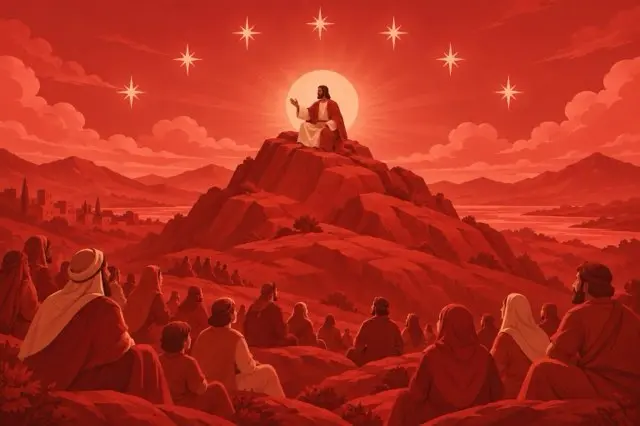
The Beatitudes are Jesus' blessings that open the Sermon on the Mount, naming the poor in spirit, the meek, and the merciful as truly blessed. They turn the world's values upside down, promising the kingdom to those who hunger for righteousness. This theme paints a portrait of the heart God delights in.
- Role
- Jesus' blessings on the kingdom heart
- Location
- Opening of the Sermon on the Mount (Matthew 5:3-12); parallel in Luke's Sermon on the Plain (Luke 6:20-26)
- Number
- Eight blessings in Matthew's account, with the first and eighth both promising "the kingdom of heaven"
- Meaning
- Makarioi (Greek) / Beati (Latin) = "blessed" or "happy", not fleeting emotion but deep well-being rooted in God's favor
- Portrait of Christ
- The Catechism teaches that the Beatitudes "depict the countenance of Jesus Christ" (CCC 1717)
- All Saints Gospel
- Read every year on All Saints Day (November 1) as a portrait of sanctity
- Key Scripture
- Matthew 5:3-12, Luke 6:20-23
More in the app
The people, places and passages behind it, in one place.
Explore Beatitudes in the appWhy This Theme Matters
"Blessed are the poor in spirit, for theirs is the kingdom of heaven." With these words, Jesus overturned everything. The world says blessed are the rich, the powerful, the satisfied. Jesus blessed the empty, the grieving, the meek. The crowds had come expecting a revolutionary who would make Israel great again. Instead, He sat down, the posture of a rabbi about to teach, and pronounced God's favor on exactly the people the world overlooks. This wasn't just ethics; it was a self-portrait. Every beatitude describes Jesus Himself: poor in spirit, mourning over sin, meek before His accusers, hungry for righteousness, merciful to sinners, pure in heart, making peace through His blood, persecuted unto death. To hear the Beatitudes is to see His face. To live them is to become like Him.
Quick Facts
- Location: Opening of the Sermon on the Mount (Matthew 5:3-12); parallel in Luke's Sermon on the Plain (Luke 6:20-26)
- Number: Eight blessings in Matthew's account, with the first and eighth both promising "the kingdom of heaven"
- Meaning: Makarioi (Greek) / Beati (Latin) = "blessed" or "happy", not fleeting emotion but deep well-being rooted in God's favor
- Portrait of Christ: The Catechism teaches that the Beatitudes "depict the countenance of Jesus Christ" (CCC 1717)
- All Saints Gospel: Read every year on All Saints Day (November 1) as a portrait of sanctity
Biblical Foundation
Old Testament Roots
The beatitude form ("Blessed is/are...") appears frequently in the Wisdom literature and Psalms. Psalm 1 opens with "Blessed is the man who walks not in the counsel of the wicked," and Psalm 31 declares "Blessed is he whose transgression is forgiven." This literary form would have been immediately recognizable to Jesus's Jewish audience.
More significantly, the content of the Beatitudes draws heavily on prophetic promises. The "poor in spirit" echoes Isaiah's vision of God's favor toward the humble and contrite (Isaiah 57:15; 66:2). "Those who mourn" being comforted fulfills Isaiah's "Book of Consolation" (Isaiah 40:1; 61:2). The meek inheriting the earth quotes Psalm 36:11 directly.
New Testament Fulfillment
Jesus delivers the Beatitudes from a mountain, deliberately evoking Moses at Sinai. Matthew presents Jesus as the new Moses bringing a new law from a new mountain. Just as Moses fasted forty days before receiving the Ten Commandments (Deuteronomy 9:9), Jesus fasted forty days before teaching the Sermon on the Mount (Matthew 4:2).
The five major teaching sections in Matthew's Gospel parallel the five books of Moses (Pentateuch), with the Sermon on the Mount corresponding to the giving of the Law in Exodus. Early Church Fathers like St. Jerome explicitly recognized this typology in his Commentary on Matthew.
Key Passages
- Matthew 5:3-12: The eight Beatitudes in their fullest form
- Luke 6:20-26: Four blessings and four corresponding woes
- Psalm 36:11: "The meek shall inherit the earth" (quoted in third beatitude)
- Isaiah 61:1-3: The anointed one who comforts mourners and brings good news to the poor
Theological Development
In Jesus's Teaching
The Beatitudes aren't arbitrary statements but a unified vision of the Christian life. St. Augustine observed a spiritual progression: the soul begins with humility (poor in spirit), becomes teachable through Scripture (meek), recognizes its sinfulness (mourning), actively pursues righteousness (hungering), shows mercy, purifies its intentions, makes peace, and ultimately faces opposition for righteousness' sake.
Each beatitude pairs a condition with a promise. The first and eighth both promise "the kingdom of heaven," creating an envelope structure. The passive blessings (poor, mourning, meek) lead to active virtues (mercy, purity, peacemaking).
In Apostolic Teaching
St. Paul's letters echo beatitude themes: "God chose what is weak in the world to shame the strong" (1 Corinthians 1:27); "when I am weak, then I am strong" (2 Corinthians 12:10). James teaches that God "chose those who are poor in the world to be rich in faith" (James 2:5).
In Church Tradition
St. Augustine's De Sermone Domini in Monte (On the Sermon of the Lord on the Mount) remains the most influential patristic commentary. He connected the Beatitudes to the seven gifts of the Holy Spirit, showing how each blessing corresponds to a spiritual gift that enables it.
Pope Francis has called the Beatitudes "the Christian's identity card," saying they "outline the face of Jesus himself, his way of life."
Key Concepts
Core Definition
The Beatitudes are solemn declarations that God's favor rests on those whom the world overlooks or pities. They announce the character of God's kingdom and the character required of its citizens, not as achievement but as gift.
The Language Behind the Blessing
The word Matthew uses is makarioi, rendered beati in Latin, from which we get "Beatitudes." It doesn't mean happy in the way we use the word over a good meal or a sunny day. It describes a deep, settled well-being that comes from standing in the favor of God, regardless of outward circumstance. When Jesus says "Blessed are the poor in spirit," He's using language His audience already knew from the Psalms and the prophets. But He's aiming it at people nobody expected. The Hebrew tradition had a word for them: anawim, "the poor ones," those who had no power, no leverage, no backup plan except God. They were the ones the Beatitudes were written for, and the Sermon on the Mount (Matthew 5-7) begins with their names on God's lips.
Common Misunderstandings
The Beatitudes are sometimes misread as entrance requirements ("be meek to enter the kingdom") rather than announcements of grace ("the meek are blessed"). They don't say poverty and mourning are good in themselves, but that these conditions create openness to God that self-sufficiency often blocks.
"Poor in spirit" doesn't mean economically wealthy but spiritually detached, it means recognizing one's spiritual poverty and need for God.
In the Liturgy
Liturgical Seasons
The Beatitudes appear in Year A on the Fourth Sunday in Ordinary Time (Matthew's version) and in Year C as part of the Sermon on the Plain. They are especially emphasized on All Saints Day, when the Church celebrates all who have lived the beatitude life.
Key Feast Days
- All Saints Day (November 1): The Gospel reading is the Beatitudes (Matthew 5:1-12a), presenting the saints as those who lived these blessings
- Fourth Sunday in Ordinary Time, Year A: The Beatitudes as Sunday Gospel
In Prayers and Sacraments
The Beatitudes inform the examination of conscience and the practice of the virtues. They appear in many prayer books and spiritual exercises as a framework for self-reflection.
Church Teaching
Catechism References
- CCC 1716: The Beatitudes are at the heart of Jesus's preaching, fulfilling promises made since Abraham
- CCC 1717: They depict the countenance of Christ and portray his charity
- CCC 1718: They respond to the natural desire for happiness that God placed in the human heart
- CCC 1725-1726: The Beatitudes teach us the final end to which God calls us: the Kingdom, the vision of God, participation in divine nature
Patristic Voices
- St. Augustine: "The sermon itself is brought to a close in such a way that it is clear there are in it all the precepts which go to mould the life."
- St. John Chrysostom: Called the Beatitudes "the laws of heaven" that invite us to a higher way of life
Practical Application
For Daily Life
The Beatitudes offer a daily examination: Am I approaching life with spiritual poverty (needing God) or self-sufficiency? Am I mourning what should be mourned, or numbing myself? Am I pursuing righteousness or just comfort?
For Prayer
Praying through the Beatitudes means asking: "Lord, show me where I am poor in spirit today. Show me what I should mourn. Make me meek, hungry for righteousness, merciful, pure, and peaceful."
For Difficult Times
The Beatitudes comfort those suffering by declaring God's special favor toward them. Mourning, persecution, and poverty of spirit are not signs of God's absence but often the very conditions where his kingdom breaks through.
For Evangelization
The Beatitudes reveal a God who is nothing like the world expects, not a God of the powerful but of the powerless. This counter-cultural vision attracts those exhausted by worldly striving.
Connections to Other Themes
- Kingdom of God: The Beatitudes describe kingdom citizens and kingdom values
- Grace: These blessings are gifts received, not achievements earned
- Humility: Poverty of spirit is the foundation of all the others
Prayer
Lord Jesus, you blessed the poor, the mourning, and the meek when the world looked right past them. Open our eyes to see your kingdom's different economy. When we find ourselves spiritually empty, grieving, or gentle in a harsh world, help us recognize that we stand exactly where your blessing falls. Form us into the image you painted in these eight words of grace. Amen.
Last Updated: 2026-01-29
Sources: Scripture, Catechism of the Catholic Church (CCC 1716-1726), St. Augustine's De Sermone Domini in Monte, Catholic Encyclopedia
Keep exploring in the app
The Bible, the map, the timeline and the whole library, in one place.
Open the app