Act of Contrition
What is the Act of Contrition?
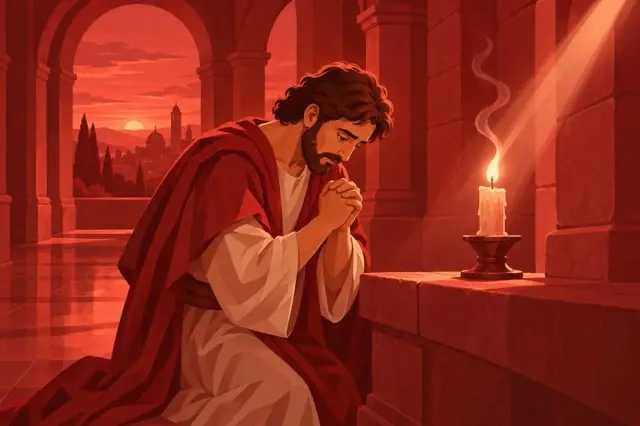
The Act of Contrition is a heartfelt prayer of sorrow for sin, traditionally prayed during the Sacrament of Reconciliation and at the close of the day. In it the believer acknowledges having wounded their relationship with God and resolves, with grace, to turn back toward him. Catholics across generations have prayed it as a tender act of returning home to a Father who waits with open arms.
- Role
- Traditional Catholic prayer
- Also Known As
- Prayer of Contrition, Mea Culpa (informal)
- Origin
- Formal acts of contrition developed in the 16th-17th century; the practice of expressing sorrow for sin is as old as the Church
- Category
- Penitential Prayer
- Scripture Basis
- Psalm 50 (Miserere); Luke 15:18-19 (Prodigal Son); 1 John 1:9
- Liturgical Use
- Sacrament of Reconciliation (Confession), examination of conscience
- When to Pray
- During Confession, evening prayer, after recognizing sin, examination of conscience
- Key Scripture
- 1 John 1:8-9, Psalm 50, Luke 15:18-19
More in the app
The people, places and passages behind it, in one place.
Explore Act of Contrition in the appThe Prayer
O my God,
I am heartily sorry for
having offended Thee,
and I detest all my sins,
because I dread the loss of heaven,
and the pains of hell;
but most of all because
they offend Thee, my God,
Who art all good and
deserving of all my love.
I firmly resolve,
with the help of Thy grace,
to confess my sins,
to do penance,
and to amend my life.
Amen.
Why This Prayer Matters
There is a moment in the confessional, after the sins have been named, after the priest has spoken, after the penance has been assigned, when the penitent is asked to pray. What comes next is the Act of Contrition: the prayer that transforms confession from a list of failures into an encounter with mercy. "O my God, I am heartily sorry for having offended Thee." These are not easy words. They require the penitent to mean what they say, to feel genuine sorrow, not just embarrassment. To detest sin not primarily because of its consequences, but because it offends a God "who art all good and deserving of all my love." For centuries, this prayer has been the bridge between guilt and grace, the moment when a sinner turns around and finds God already running toward them.
The Story Behind the Prayer
The Tradition of Penance
From the earliest days of the Church, Christians understood that baptism was not the end of the struggle with sin but the beginning. The letters of Paul are filled with exhortations to Christians who have fallen. The first epistle of John states plainly:
“If we claim that we have no sin, then we are deceiving ourselves and the truth is not in us. If we confess our sins, then he is faithful and just, so as to forgive us our sins and to cleanse us from all iniquity.”, 1 John 1:8-9
The early Church developed public penance for serious sins, long periods of fasting, prayer, and exclusion from Communion before restoration. By the sixth century, Irish monks had developed the practice of private, repeated confession to a priest, the ancestor of the confessional we know today.
Two Kinds of Sorrow
Catholic theology distinguishes between imperfect contrition (attrition) and perfect contrition. Imperfect contrition arises from fear, fear of hell, fear of punishment, fear of consequences. Perfect contrition arises from love, sorrow because sin offends God, who is infinitely good.
The Act of Contrition names both: "I dread the loss of heaven and the pains of hell" (imperfect contrition), "but most of all because they offend Thee, my God, who art all good" (perfect contrition). The prayer is honest about where most of us start, with fear, and then leads us toward where God wants us to arrive, at love.
A Prayer That Resolves
The Act of Contrition does not stop at sorrow. Its final lines move from feeling to decision: "I firmly resolve, with the help of Thy grace, to confess my sins, to do penance, and to amend my life." Genuine contrition includes a firm purpose of amendment, not a guarantee of perfection, but a real intention to change, sustained not by willpower but by grace.
What This Prayer Means
The Act of Contrition is structured as a complete movement of conversion. It begins with sorrow ("I am heartily sorry"), moves through honesty ("I detest all my sins"), acknowledges both fear and love as motivations, and concludes with resolve ("I firmly resolve... to amend my life").
The phrase "with the help of Thy grace" is crucial. The prayer does not say "I resolve by my own strength." It acknowledges that even the resolve to change is a gift. The penitent is not pulling themselves up by their own bootstraps, they are asking to be lifted.
The prayer's audience is God directly: "O my God." Not the priest, not the community, not an abstract deity, my God. Contrition is personal. It happens in the most intimate space of the human heart, in the space between a sinner and the God they have offended and who still loves them.
Why It Matters Today
The Living Practice
The Act of Contrition is prayed during the Sacrament of Reconciliation (Confession), typically after the priest has given absolution and penance. Many Catholics also pray it during their nightly examination of conscience, as a way of closing the day with honesty before God.
Multiple versions exist, some longer, some shorter, some modern, some traditional. The essential elements are always the same: genuine sorrow for sin, acknowledgment that sin offends God, and a firm resolve to change with the help of grace.
For many Catholics, memorizing the Act of Contrition is one of the milestones of childhood faith formation, learned before First Reconciliation and carried through a lifetime of returning to God.
Lessons for Us
1. Sorrow is not enough: The prayer moves from sorrow to resolve. Christianity does not ask us to wallow in guilt but to let guilt lead to change. Contrition without amendment is incomplete.
2. Love surpasses fear: The prayer is honest that we begin with fear of consequences, but "most of all" because we have offended a God who is good. Growth in the spiritual life means moving from fear-based to love-based repentance.
3. Grace enables change: "With the help of Thy grace", we cannot amend our lives alone. The same God we have offended supplies the power to stop offending. Repentance is itself a gift.
Quick Facts
- Also Known As: Prayer of Contrition, Mea Culpa (informal)
- Origin: Formal acts of contrition developed in the 16th-17th century; the practice of expressing sorrow for sin is as old as the Church
- Category: Penitential Prayer
- Scripture Basis: Psalm 50 (Miserere); Luke 15:18-19 (Prodigal Son); 1 John 1:9
- Liturgical Use: Sacrament of Reconciliation (Confession), examination of conscience
- When to Pray: During Confession, evening prayer, after recognizing sin, examination of conscience
Going Deeper
Scripture References
- The Model Penitent: Psalm 50, David's prayer after his sin with Bathsheba
- The Prodigal Son: Luke 15:11-32, "Father, I have sinned against heaven and before you"
- Peter's Tears: Luke 22:62, Peter wept bitterly after denying Christ
- God's Faithfulness: 1 John 1:9, "If we confess our sins, He is faithful and just to forgive"
Church Teaching
- Catechism: CCC 1451, "Among the penitent's acts, contrition occupies first place. Contrition is 'sorrow of the soul and detestation for the sin committed, together with the resolution not to sin again.'"
- CCC 1452-1453: Distinguishes perfect contrition (from love of God) and imperfect contrition (from fear), both are genuine, but perfect contrition is the goal
- Council of Trent: Defined contrition as necessary for valid reception of the Sacrament of Reconciliation
Keep exploring in the app
The Bible, the map, the timeline and the whole library, in one place.
Open the app